Surviving Southampton by Vanessa M. Holden
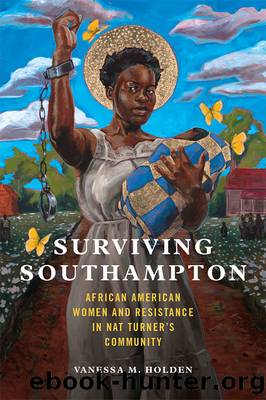
Author:Vanessa M. Holden [Holden, Vanessa M.]
Language: eng
Format: epub
Tags: History, General, African American & Black, Social Science, Women's Studies, United States, 19th Century
ISBN: 9780252052767
Google: LggyEAAAQBAJ
Publisher: University of Illinois Press
Published: 2021-07-13T01:05:14+00:00
Navigating the Court Proceedings: A Geography of Punishment and Incarceration
The trials that followed the Southampton Rebellion were not unique in their form or their function. Like courts convened for generations in Virginia, the court of oyer and terminer that tried suspected rebels was a theater where white males performed their mastery and executed their very real power over Black peopleâs lives. These courts were embedded in long-standing cultural and legal tradition. Residents built the countyâs first courthouse when Virginia was still a colony. After independence from England, Jerusalem became the county seat of Southampton because of its importance to the countyâs legal history. It became the location where local criminal and civil courts convened and circuit court days took place.17
On court days, Jerusalem served as a gathering place where residents could socialize, share news from court proceedings, and make up their own minds about trial outcomes. In the early antebellum period, a courthouse, the surrounding grounds, and even the courtroom could be boisterous arenas for public participation in legal proceedings. Court days were social occasions and community events. It was not unusual for confrontations to take place outside the courtroom in response to rulings that crowds deemed unjust.18
In the fall of 1831, local officials faced a community that was frighteningly out of order to them. Enslaved people had managed to murder their neighbors and kin, and the scope of the rebellion was still unknown when trials began in Jerusalem. Turnerâs absence loomed. Regaining control, placing that control in the hands of the right sort of white men, and reestablishing hierarchical order was paramount. To that end, justices were tasked with trying as many suspects as were needed to restore the peace. As Patrick Breen points out in his assessment of the county court records, âFirmly in control of the courtâs proceedings, Southamptonâs elite used the trial to promote their interpretation of the revolt: it was a small affair involving only a few slaves.â19 This narrative benefited the broader community of whites who were eager to know that both class and racial hierarchy had been restored. It behooved them to believe that most of their human property did not want them dead. And it benefited enslavers financially to execute and sell as few enslaved people as possible.
All of the justices who served in the county court were enslavers with considerable holdings.20 Their status in the community made them eligible to serve as magistrates. Although some antebellum magistrates might have had legal training, a legal education was not a requirement. Instead, communities looked to white men they trusted to best keep the peace. As historian Laura Edwards notes, âKeeping the peace meant keeping everyoneâfrom lowest to highestâin their appropriate places, as defined in specific local contexts.â21 The men who served as local magistrates were expected to know the community they served and to understand the unique needs of that community. They would have known how important enslaved labor was to each of their neighbors based on their experiences and relationships with them.
Download
This site does not store any files on its server. We only index and link to content provided by other sites. Please contact the content providers to delete copyright contents if any and email us, we'll remove relevant links or contents immediately.
| Africa | Americas |
| Arctic & Antarctica | Asia |
| Australia & Oceania | Europe |
| Middle East | Russia |
| United States | World |
| Ancient Civilizations | Military |
| Historical Study & Educational Resources |
Cat's cradle by Kurt Vonnegut(15441)
Pimp by Iceberg Slim(14664)
4 3 2 1: A Novel by Paul Auster(12509)
Underground: A Human History of the Worlds Beneath Our Feet by Will Hunt(12144)
The Radium Girls by Kate Moore(12091)
Wiseguy by Nicholas Pileggi(5841)
The Fire Next Time by James Baldwin(5503)
Perfect Rhythm by Jae(5460)
American History Stories, Volume III (Yesterday's Classics) by Pratt Mara L(5337)
Paper Towns by Green John(5247)
Pale Blue Dot by Carl Sagan(5080)
A Higher Loyalty: Truth, Lies, and Leadership by James Comey(5017)
The Doomsday Machine by Daniel Ellsberg(4542)
The Mayflower and the Pilgrims' New World by Nathaniel Philbrick(4540)
Killers of the Flower Moon: The Osage Murders and the Birth of the FBI by David Grann(4488)
The Sympathizer by Viet Thanh Nguyen(4443)
Too Much and Not the Mood by Durga Chew-Bose(4386)
The Borden Murders by Sarah Miller(4378)
Sticky Fingers by Joe Hagan(4253)
